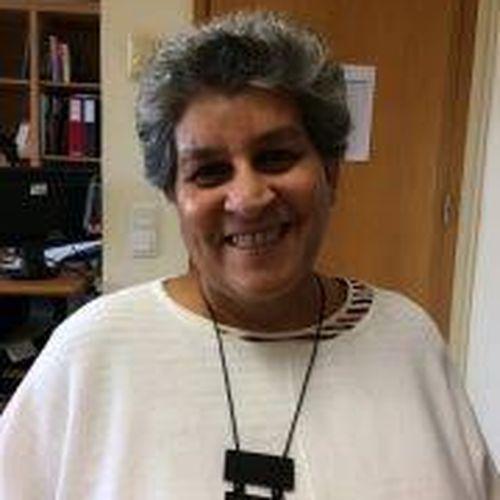
From Kuxa Kanema to the canvas
Isabel Noronha is one of the defining names of Mozambican cinema and one of the first Mozambican women to direct film. Born in Maputo on 18 March 1964, she joined the National Film Institute in 1984, at the age of twenty, working through every craft of the weekly newsreel Kuxa Kanema — from production assistant to director. She was a founding member of Coopimagem, Mozambique's first independent video cooperative, and of the filmmakers' association AMOCINE, where she is responsible for training.
Her documentary Ngwenya, o Crocodilo (2007), on the painter Malangatana Valente Ngwenya, was distinguished at the Milan Festival of African, Asian and Latin American Cinema as best documentary (2009). Her films have also won the Kuxa Kanema Prize for best Mozambican film (Trilogia das Novas Famílias, 2007), first prize at Documenta Madrid (Espelho Meu, 2011) and, with Camilo de Sousa, the best-documentary award at the XXX Caminhos do Cinema Português (Coimbra, 2024) for À Mesa da Unidade Popular.
Alongside cinema, she holds a degree in clinical psychology, a master's in mental health (University of León, 2007) and a doctorate in social anthropology (UNICAMP, Brazil, 2018), and is an associate researcher at the Institute of Social Sciences of the University of Lisbon. Painting is the most recent facet of her visual universe — presented publicly in Idasse & Friends — Colours of Mozambique.